
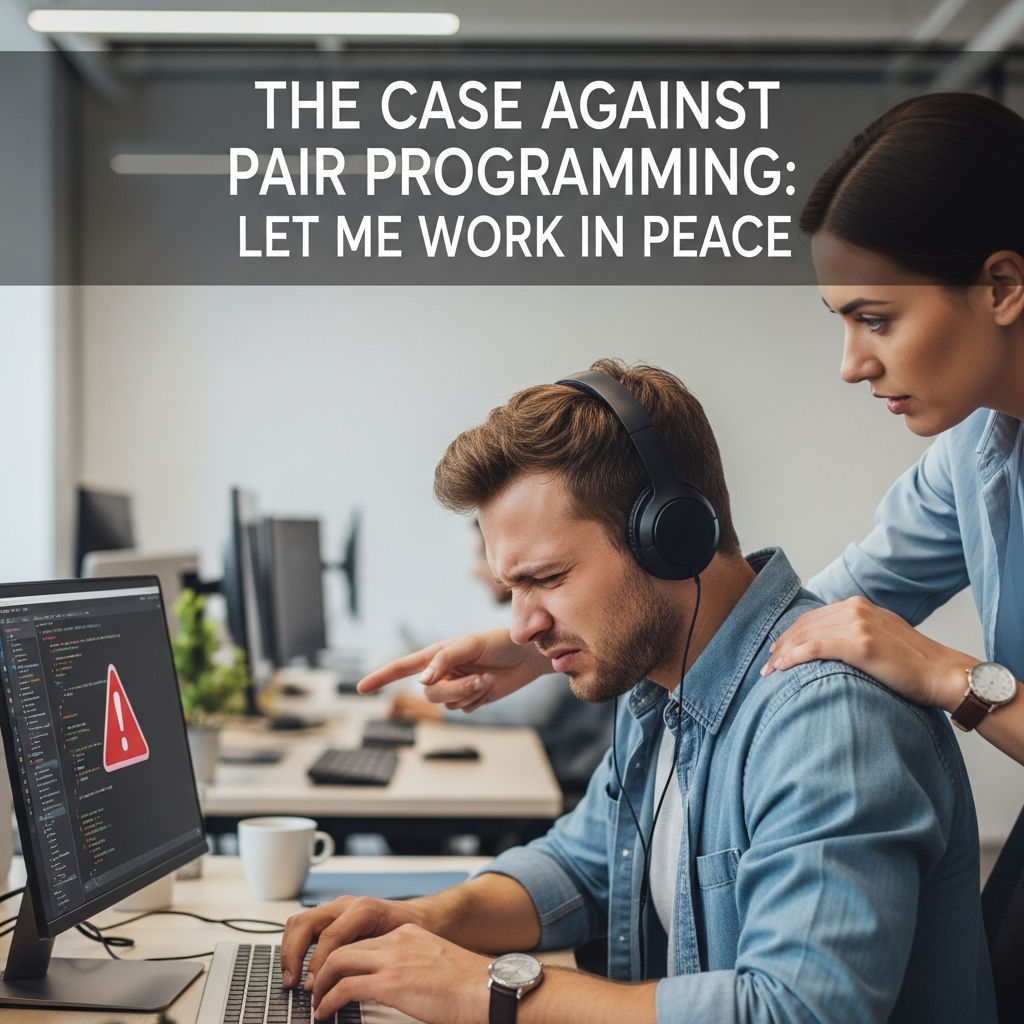
The Case Against Pair Programming: Let Me Work in Peace
For over two decades, the software development world has been swept up in the fervor of Agile methodologies. Among the most championed practices is pair programming—a technique where two developers sit at one workstation, one “driving” (typing) while the other “navigates” (reviewing and planning). Proponents claim it leads to fewer bugs, better knowledge sharing, and higher-quality code.
However, for many developers, the reality of pair programming is far less utopian. Instead of a collaborative symphony, it often feels like a forced marriage that kills productivity, drains mental energy, and obliterates the most sacred state in programming: the flow state. It is time to look critically at the “Agile dogma” and make a case for the individual developer’s right to work in peace.
The Death of the Flow State
Programming is not a clerical task; it is a creative, cognitive process that requires deep focus. In his seminal book Deep Work, Cal Newport emphasizes that high-level intellectual output is only possible during periods of uninterrupted concentration. This is commonly referred to in the tech world as the “flow state.”
When you are in the zone, you hold a complex mental model of the entire system in your head. You are tracing variables, anticipating edge cases, and visualizing data structures. Pair programming systematically dismantles this state. Every time your partner asks a question, points out a typo while you’re still typing, or suggests an alternative approach mid-thought, the mental model collapses. The cost of “re-loading” that context is immense, often taking 15 to 20 minutes to recover. In a four-hour pairing session, a developer might never actually reach a state of deep focus.
The Problem of “Thinking Out Loud”
Pair programming requires developers to verbalize their thought process. While this sounds good in theory for knowledge transfer, it is a massive cognitive tax. The part of the brain responsible for complex logic is not the same part responsible for articulate speech. Forcing a developer to translate abstract logic into spoken words in real-time slows down the problem-solving process and adds an unnecessary layer of exhaustion.
The Introvert’s Nightmare: Social Exhaustion
It is no secret that the software engineering profession attracts a high percentage of introverted individuals. For an introvert, social interaction—no matter how positive—expends energy. Pair programming turns a job that should be a sanctuary of logic into an eight-hour social performance.
- Performative Coding: When someone is watching you, you are less likely to experiment. You take fewer risks because you don’t want to look “stupid” trying a solution that might fail. This stifles innovation and leads to safe, boring, and sometimes less-than-optimal code.
- The Energy Drain: By the end of a full day of pairing, many developers are too socially exhausted to engage with their families or hobbies. This “collaboration fatigue” is a fast track to burnout, a leading cause of turnover in the tech industry.
- Hyper-Self-Consciousness: Simple tasks, like looking up documentation or searching for a solution on Stack Overflow, become sources of anxiety. You feel judged for not knowing an API by heart, leading to a frantic attempt to appear more “senior” than you might feel in that moment.
The Myth of 2x Productivity
The economic argument for pair programming is that two people working on one task will produce code so much better that it offsets the 100% increase in man-hours. But does the math actually work? Research on pair programming is mixed at best. While it can reduce certain types of bugs, it often results in a significant slowdown in total feature delivery.
The Efficiency Paradox
In many scenarios, a senior developer pairing with a junior developer results in the senior developer essentially doing the work while narrating it, or the junior developer becoming a passive observer. This is often called “passenger syndrome.” Instead of two people contributing, you have one person working at 60% speed due to the distraction, and another person not working at all.
Diminishing Returns on Quality
Modern development workflows already include a safety net: the Asynchronous Code Review (Pull Request). A well-executed PR provides a “second set of eyes” without requiring the synchronous time-sink of pairing. The reviewer can look at the code with fresh eyes and a calm mind, often catching errors that two people “stuck in the weeds” during a pairing session might both overlook.

The Power Dynamics and “Driver” Dominance
Pair programming assumes an egalitarian relationship between two developers, but human psychology rarely works that way. Power dynamics—whether based on seniority, personality type, or tenure at the company—inevitably take over.
If one person is more assertive, they will dominate the session. The “navigator” might stop navigating and start browsing their phone, or the “driver” might ignore the navigator’s suggestions. This creates resentment and a toxic work environment. Instead of collaboration, you get a situation where one person feels micromanaged and the other feels like they are dragging a heavy weight.
When Should We Actually Pair?
The case against pair programming isn’t a call for its total abolition; it’s a call for its intentional and limited use. Pair programming is a tool, not a lifestyle. It is highly effective in specific scenarios:
- Onboarding: Helping a new hire get their environment set up and understand the codebase.
- Kicking off a complex task: Spending 30 minutes to white-board an architecture before going off to code individually.
- Rubber Ducking: When a developer is genuinely stuck and needs a fresh perspective to break through a logic gate.
- High-Stakes Debugging: When a production system is down and “two heads are better than one” to prevent panic-driven mistakes.
Outside of these specific “high-utility” moments, mandatory, all-day pair programming is an organizational inefficiency disguised as a best practice.
Trust Developers to Choose Their Method
The ultimate argument against mandatory pair programming is one of autonomy. Software developers are highly skilled professionals. They are hired for their ability to solve problems and manage their own cognitive resources. Dictating how they sit at their desk and how they interact with their screen is a form of micro-management that signals a lack of trust.
Some developers love pairing. They find it energizing and helpful. Others find it a grueling obstacle to their best work. A healthy engineering culture should be flexible enough to accommodate both. If a team wants to pair, let them. But if a developer says, “I need to put my headphones on and solve this alone,” that request should be respected, not viewed as a failure to be a “team player.”
Conclusion: The Value of Solitude
In our rush to make software development a social, collaborative “experience,” we have forgotten that at its core, coding is an act of solitary creation. It is a conversation between a human and a machine. By forcing a second human into that conversation, we often break the very connection that leads to elegant, efficient, and thoughtful code.
Let’s stop treating pair programming as a mandatory ritual. Let’s bring back the quiet office, the deep focus, and the respect for the individual contributor. Sometimes, the best thing a teammate can do for a project is to leave their colleague alone and let them work in peace.