
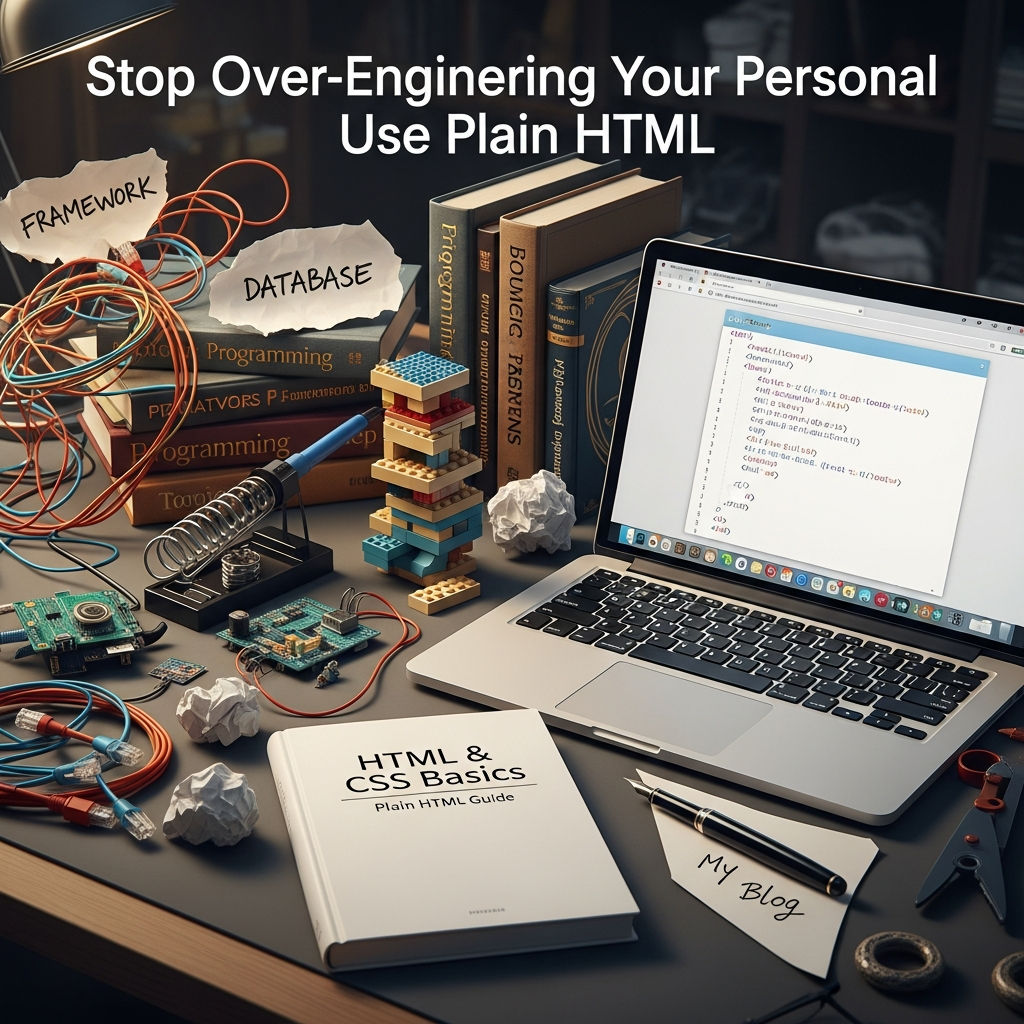
Stop Over-Engineering Your Personal Blog: Why Plain HTML is Still King
In the modern era of web development, we are spoiled for choice. If you want to start a personal blog, the industry will point you toward Next.js, Gatsby, Hugo, or perhaps a Headless CMS coupled with a GraphQL API and a Tailwind CSS configuration. We spend weeks configuring package.json files, setting up CI/CD pipelines, and debating the merits of Server-Side Rendering (SSR) versus Static Site Generation (SSG).
Then, after forty hours of development work, we realize we haven’t actually written a single blog post. This is the over-engineering trap. We treat a personal blog—a simple collection of text and images—as if it were a high-scale enterprise application. In the process, we sacrifice speed, longevity, and the joy of writing. If you want to reclaim your digital space, it’s time to return to the basics: Plain HTML.
The Framework Trap: Why Developers Over-Engineer
Why do we choose complex stacks for simple tasks? For developers, a personal blog is often a playground or a portfolio piece. We want to show potential employers that we know the latest libraries. We want to play with the “shiny new thing.” However, there is a fundamental difference between a web application and a web document.
A blog is, at its heart, a document. When we wrap that document in 100MB of node_modules, we introduce “dependency rot.” In three years, that React-based blog likely won’t even build on your machine without a dozen breaking change fixes. A plain HTML file, however, will render exactly the same way in 2050 as it does today.
The Benefits of a Plain HTML Blog
Choosing a minimalist approach isn’t just about nostalgia; it’s about pragmatism. Here is why plain HTML (and perhaps a sprinkle of CSS) is the ultimate stack for a personal writer.
1. Unmatched Performance and SEO
Google’s search algorithms prioritize Core Web Vitals. These metrics measure load speed, interactivity, and visual stability. A plain HTML site has no “hydration” phase. There are no JavaScript bundles to parse or execute. When a user clicks your link, the content is there instantly.
- Lighthouse Scores: You will hit 100/100 on performance without even trying.
- Lower Bounce Rates: Readers don’t have to wait for a loading spinner to read a 500-word essay.
- Crawlability: Search engine bots can index your content perfectly because there is no client-side rendering logic to navigate.
2. The Longevity of Simple Code
The “Lindy Effect” suggests that the longer something has survived, the longer it is likely to survive in the future. HTML has been around for over 30 years. It is the most stable contract in computing. If you write your blog in plain HTML, you are creating a digital legacy that isn’t dependent on the survival of a specific framework or a corporate-backed library.
3. Zero Maintenance and Security
Modern web stacks require constant updates. You have to patch security vulnerabilities in your dependencies and update your build tools. A static HTML site has no moving parts. There is no database to hack, no server-side logic to exploit, and no “breaking changes” in the HTML5 spec that will take your site offline. Once it’s uploaded, it stays up.
Regaining the Joy of Writing
Over-engineering creates a “barrier to entry” for your own creativity. When your blog requires you to run npm run dev, wait for a compiler, and navigate a complex folder structure just to fix a typo, you are less likely to write. Friction is the enemy of consistency.
When you use plain HTML, the workflow is refreshing. You open a file, type your thoughts inside a <p> tag, and save. There is a psychological lightness to knowing that your words aren’t buried under layers of abstraction. You become a writer again, rather than a system administrator for your own thoughts.

How to Build a “Modern” Plain HTML Blog
Using plain HTML doesn’t mean your site has to look like it’s from 1995 (unless you want it to). You can still have a beautiful, responsive, and functional site using a minimalist toolkit.
Step 1: Use Semantic HTML
Focus on structure. Use <header>, <main>, <article>, and <footer>. This ensures accessibility for screen readers and helps SEO by telling search engines exactly what each part of your page represents.
Step 2: Minimalist CSS
You don’t need a CSS-in-JS library. A single style.css file is all you need. If you aren’t a designer, you can use “classless” CSS frameworks like Sakura, Picnic CSS, or Water.css. You simply link the stylesheet in your HTML head, and it automatically styles your standard tags into a readable, modern layout.
Step 3: Easy Hosting
Since your site is just a collection of files, you can host it anywhere for free. GitHub Pages, Netlify, and Vercel all allow you to drop a folder of HTML files and go live in seconds. You aren’t paying for server time or database compute—you are just serving static assets.
When Should You Use a Tool?
Is there ever a time to use a generator? If your blog grows to over 50 or 100 posts, managing a manual “Archive” page or navigation menu can become tedious. This is where a Static Site Generator (SSG) like Eleventy (11ty) comes in.
Eleventy is the “anti-framework” framework. It doesn’t ship any JavaScript to the client. It simply takes your content and injects it into your HTML templates during the build process. It allows you to keep the simplicity of HTML while gaining the power of templates and automated lists. It is the logical middle ground for someone who wants to avoid over-engineering but needs a bit of automation.
Conclusion: The Power of Less
We live in an era of digital bloat. The average webpage today is the same size as the original DOOM install files. By choosing plain HTML for your personal blog, you are making a statement. You are prioritizing the reader’s experience, the longevity of your ideas, and your own mental clarity.
Stop worrying about your build pipeline. Stop tweaking your Webpack config. Stop searching for the “perfect” CMS. Open a text editor, create index.html, and start writing. The web was built on simple tags and big ideas—keep it that way.
Summary Checklist for Your Simple Blog:
- Keep it static: No databases, no login systems, no unnecessary complexity.
- Prioritize HTML: Use semantic tags for better SEO and accessibility.
- External CSS: Keep your styling in one file to maintain a clean separation of concerns.
- Focus on Content: If you spend more time coding the blog than writing for it, you’ve over-engineered it.